

Cornerstone Concentrated 30 US Equity Fund
LEI : 213800JOCGETWX4P1D38
table of contents:
1. Summary
The Cornerstone Concentrated 30 US Equity Fund (the “Fund”) seeks to deliver long‑term capital growth by investing predominantly in a concentrated portfolio of equity securities of large, highly liquid companies listed or traded on recognised U.S. markets. The Fund is managed using a high‑conviction, bottom‑up investment approach, underpinned by detailed fundamental analysis and proprietary valuation techniques, including the Sub‑Investment Manager’s Fair Value Model. The portfolio is typically comprised of approximately 30 holdings, with position sizes determined by relative attractiveness, risk considerations and the degree of mispricing relative to the Sub‑Investment Manager’s assessment of underlying fundamentals.
The Fund promotes environmental and social (“E/S”) characteristics but does not have sustainable investment as its objective and does not have a designated reference benchmark for the purpose of measuring the attainment of those characteristics. Environmental, social and governance (“ESG”) considerations are integrated into the Fund’s investment process as part of the Sub‑Investment Manager’s assessment of business quality, risk and long‑term sustainability, alongside traditional financial analysis.
The environmental characteristics promoted by the Fund include reducing reliance on fossil fuels by avoiding investments in companies that derive more than 10% of their revenue from thermal coal production. The social characteristics promoted by the Fund include improving human rights and labour standards, promoting anti‑corruption practices through investment in companies that uphold the principles of the United Nations Global Compact (“UNGC”) or demonstrate credible progress in improving their E/S practices, avoiding exposure to controversial weapons by excluding companies with any revenue derived from such activities, and promoting responsible investing by excluding companies that derive more than 10% of their revenue from tobacco production.
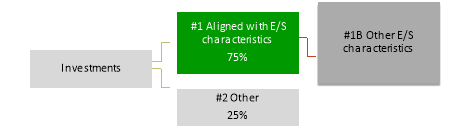
In addition to the application of exclusionary screens, the Sub‑Investment Manager promotes the Fund’s E/S characteristics by embedding ESG analysis into its investment decision‑making and portfolio construction processes. This includes limiting aggregate exposure to ESG “laggards” to no more than 25% of the Fund’s portfolio. ESG laggards are identified based on relative ESG score positioning, using data from multiple third‑party ESG data providers, where a company’s ESG performance is assessed as materially below the relevant market average. Where investments in ESG laggards are retained, this is typically because the Sub‑Investment Manager believes the company is on a credible improvement trajectory, supported by measurable progress, improved ESG ratings, reduced controversy exposure or constructive engagement. Such holdings are subject to enhanced monitoring and ongoing review.
The Fund invests at least 90% of its equity investments in companies traded on U.S. exchanges. The investment universe generally comprises approximately 800 companies, providing exposure to global businesses through U.S. listings. The Fund may also hold cash or money market instruments for the purpose of efficient portfolio management purposes.
The environmental and social characteristics promoted by the Fund are monitored on an ongoing basis using data sourced from multiple third‑party ESG data providers, including but not limited to MSCI, as well as company disclosures, Bloomberg data and news monitoring. These data inputs provide information on ESG scores and sub‑scores, ESG risk exposure, performance metrics, controversy involvement and UNGC compliance. The use of multiple data sources enables the Sub‑Investment Manager to form a holistic and comparative assessment of each company’s ESG performance and to identify trends, risks and areas for engagement over time.
The Sub‑Investment Manager applies a structured methodology to assess, measure and monitor the E/S characteristics promoted by the Fund, both at the point of investment decision‑making and throughout the holding period. ESG considerations are evaluated alongside governance factors as part of the overall assessment of a company’s quality, resilience and long‑term value creation potential. Governance is considered a critical component of risk management and includes assessment of board structure, management incentives, business ethics, accounting standards and capital allocation discipline.
The Sub‑Investment Manager recognises that ESG data and methodologies are subject to limitations, including differences in rating methodologies across providers, inconsistent or incomplete company reporting, time lags in data updates, reliance on estimates and the inherently backward‑looking nature of certain indicators. These limitations are mitigated through the use of multiple data sources, ongoing company engagement and the integration of internal research and qualitative analysis to complement third‑party data.
ESG due diligence is conducted both prior to investment and on an ongoing basis. Pre‑investment due diligence includes assessment of ESG risks, controversies, UNGC compliance and governance practices, drawing on third‑party data, internal analysis and publicly available disclosures. Companies that fail to meet the Fund’s exclusion criteria or present unmitigated ESG risks inconsistent with the E/S characteristics promoted by the Fund are excluded from the investable universe. Following investment, ESG monitoring continues, and where a company’s ESG profile deteriorates or new risks emerge, the Sub‑Investment Manager may engage with company management, apply enhanced monitoring, reassess the investment’s alignment with the Fund’s E/S characteristics, or reduce or exit the position where risks are considered material and unaddressed.
Further information on proxy voting and engagement activities is available in the Sub‑Investment Manager’s engagement and voting policies, which can be provided on request.
2. No sustainable investment objective
The Fund promotes environmental and social characteristics but does not have sustainable investment as its objective.
3. Environmental or social characteristics of the financial product
The Fund promotes environmental and social (“E/S”) characteristics such as
Environmental
- Reducing fossil fuel reliance by avoiding investment in companies which derive >10% of their revenue from thermal coal production.
Social
- Improving human rights, labour rights and promoting anti-corruption measures through investing in companies that uphold the principles of the UN Global Compact (“UNGC) or demonstrating taking active steps to improving its E/S behaviours, as assessed by the Sub-Investment Manager;
- Avoiding the financing of controversial weapons by excluding investment in companies which derive >0% revenue in controversial weapons; and
- Promotion of responsible investing by excluding investments in companies which derive >10% revenue in tobacco production.
Additionally, the Sub-Investment Manager promotes the E/S characteristics of the Fund through:
(1) limiting exposure to ESG “laggards” (defined herein) to no more than 25% of the portfolio of the Fund. The Sub-Investment Manager embeds ESG scores into its investment analysis by first receiving data inputs from multiple third party ESG data providers (such as, but not limited to, MSCI). These providers embed materiality of ESG considerations into their ratings and provide the Sub-Investment Manager with ESG scores, risk exposure, performance, controversy involvement, and UNGC compliance in respect of each company. This data permits the Sub-Investment Manager to get a holistic understanding of each company’s ESG performance. At the point of investment decision making, and on an ongoing basis, if a company is regarded and confirmed as an ESG laggard (defined as a company whose ESG scores, as determined by the Sub-Investment Manager using data from third party ESG data providers falls approximately one or more standard deviations below the relevant mean score of the market at the time of assessment) then this holding would not be deemed as promoting the E/S characteristics of the Fund. The Sub-Investment Manager may retain investments in ESG laggards for a number of reasons, including where it believes that the company is on a credible improvement trajectory, evidenced by, for example, publicly disclosed ESG improvement targets, measurable progress against identified ESG weaknesses, improved ESG ratings or reduced controversy exposure over time, or where engagement with the company is expected to drive positive change. In such cases, the Sub-Investment Manager will monitor these holdings closely and may engage with the company to encourage improved ESG practices. The retention of such investments does not detract from the overall promotion of the E/S characteristics of the Fund, as exposure to ESG laggards is limited to no more than 25% of the portfolio; and
(2) abiding to the exclusion criteria.
4. Investment strategy
The Fund seeks to deliver long-term capital growth by investing predominantly in equity securities of large, highly liquid companies that are listed or traded on recognised U.S. markets. To achieve this, the Sub-Investment Manager applies a rigorous, team-driven investment process grounded in detailed fundamental analysis and proprietary valuation (including Cornerstone’s proprietary ‘Fair Value Model’) techniques. The Fair Value Model determines a fair price for a stock by assessing its normalised earnings potential and applying an appropriate multiple to those earnings. This approach takes into account fundamental factors such as profitability, growth rates, and both financial and operational leverage. The selection process aims to uncover opportunities where market participants have mispriced stocks, often due to cognitive biases or behavioural inefficiencies. The Fund will invest at least 90% of its equity investments in U.S. domiciled companies or companies included in major U.S. indices. The investment universe generally consists of approximately 800 multinational corporations, including select non-U.S. companies that are traded on U.S. exchanges, providing broad exposure to global businesses through U.S. listings.
The Sub-Investment Manager's investment research process includes, as relevant and unique to each current or potential security, a review of a company’s management team and governance structure, including, but not limited to, voting, board structure and representation, management incentives, and the history of strategic and capital allocation decisions. As minority shareholders in publicly traded securities, the Sub-Investment Manager believes good corporate governance is vital to ensure client capital is fairly, appropriately, and efficiently managed. Good governance is a clear advantage supporting the Sub-Investment Manager’s perspective on the relevance and repeatability of a company’s prior track record and fundamental quality, and actively reviews for and promotes good governance in its investment research process.
Governance factors also play a crucial role in the Sub-Investment Manager’s risk analysis for a given company. Without strong corporate governance practices, or having a history of poor corporate ethics or non-compliance with established accounting or legal standards will affect the Sub-Investment Manager’s assessment of the quality of the management team and/or board and the Sub-Investment Manager’s confidence in them. Governance factors may include, among others:
- Business ethics;
- Accounting standards;
- Board structure and oversight; and/or
- Conflicts of interest.
Under normal market conditions, the Fund will maintain a concentrated portfolio consisting of 30 holdings at any given time. However, the number of holdings may temporarily deviate from 30 as a result of trading activity, including the timing of trade execution and settlement. Any such deviation will be temporary in nature. Positions are selected through a bottom-up process that emphasises stock selection over sector allocation. Position sizes and sector weights are determined based on relative attractiveness, risk considerations, and the degree of mispricing to the Sub-Investment Manager’s assessment of fair value of the stock based on its underlying fundamentals, rather than its current market price.
5. Proportion of investments
The Fund aims to achieve its objective by investing predominantly in a concentrated portfolio of equity securities, including common stocks of U.S. large cap companies or American Depository Receipts. The Fund may also hold cash or money market instruments, and the Fund may use derivative instruments for the purposes of efficient portfolio management and hedging under the conditions and within the limits laid down by the Central Bank.
6. Monitoring of environmental or social characteristics
The environmental and social characteristics promoted by the Fund, together with the governance factors, support the attractiveness of companies as long-term portfolio holdings for the Fund. The Sub-Investment Manager receives data inputs from multiple third party ESG data providers (such as, but not limited to, MSCI). These providers embed materiality of ESG considerations into their ratings and provide the Sub-Investment Manager with ESG scores, risk exposure, performance, controversy involvement, and UNGC compliance in respect of each company.
When assessing the environmental and social indicators, and on an ongoing basis, together with the consideration of governance factors, the Sub-Investment Manager also aims to:
- Form a holistic view of a company’s ESG performance
- Understand where companies are on a credible improvement trajectory
- Engage with the company to encourage improved ESG practices.
7. Methodologies
The Sub‑Investment Manager applies a structured and systematic methodology to assess, measure and monitor the environmental and/or social (“E/S”) characteristics promoted by the Fund.
The Sub‑Investment Manager embeds ESG considerations into its investment analysis by sourcing ESG data from multiple third‑party ESG data providers (including, but not limited to, MSCI). These data providers integrate the materiality of ESG considerations into their methodologies and provide company‑level information including:
- ESG scores and sub‑scores
- ESG risk exposure and performance metrics
- Involvement in ESG‑related controversies
- Compliance with the United Nations Global Compact (“UNGC”) principles
The use of multiple data inputs enables the Sub‑Investment Manager to form a holistic and comparative assessment of each company’s ESG performance relative to peers and the broader market.
At the point of investment decision‑making, and on an ongoing basis thereafter, the Sub‑Investment Manager assesses whether a company qualifies as an ESG laggard based on its relative ESG score positioning. Where a company is identified and confirmed as an ESG laggard:
- such holding is not considered to be promoting the environmental and/or social characteristics of the Fund for SFDR purposes; and
- exposure to such holdings is managed in line with the Fund’s commitment to limit aggregate exposure to ESG laggards to no more than 25% of the portfolio.
8. Data sources and processing
The data sources used to analyse the financially material environmental and social characteristics of the fund may include:
- Bloomberg data;
- Company reports;
- MSCI company ratings;
- Monitoring of articles and news.
These data sources allow the Sub-Investment Manager to understand the ESG performance of each holding, explore and analyse the sustainability profile of individual issuers and monitor compliance with policies and investment approach. Each factor is company and sector specific which also determines its financial materiality to future earnings and profitability.
To support data quality, the Sub-Investment Manager undertakes initial and ongoing due diligence on the portfolio stocks and their ESG performance, including the availability of ESG data. Where multiple data sources are available for the same indicator, these are reviewed on a comparative basis to identify material discrepancies or outliers. ESG data is reviewed as part of the Fund’s broader investment research process and is considered alongside qualitative assessment and fundamental analysis.
ESG data from third-party providers is processed and integrated into the Sub-Investment Manager’s internal research. Data is reviewed at the point of investment decision making and on an ongoing basis thereafter. The nature of the investable universe (large cap stocks traded on US exchanges) means that data gaps are minimal and ESG data coverage is high. Where a data gap or potential error is identified, the Sub-Investment Manager may supplement third-party data with additional issuer disclosures, internal analysis or engagement with company management. Again, third-party providers are unlikely to need to use estimates when reporting ESG data given the investable universe for this Fund, should this situation arise the Sub-Investment Manager does not seek to rely exclusively on estimated data.
Overall, the Sub‑Investment Manager considers that the combination of multiple data sources, internal review processes and ongoing monitoring provides a reasonable basis for assessing and monitoring the environmental and social characteristics promoted by the Fund, while recognising the inherent limitations of ESG data.
9. Limitations to methodologies and data
Limitations on methodologies and ESG data include the lack of consistency, reliability, comparability, and quality of the data available. This is driven by issues including, but not limited to:
- Lack of common methodology across providers of ESG ratings;
- Lack of standardised reporting by companies;
- Lack of timely updated data across providers of ESG ratings;
- Different estimation models for unreported data;
- Difficult to quantify factors and unverified or unaudited information; and
- Backward looking information that fails to capture “direction of travel”.
The Sub-Investment Manager attempts to address these limitations by:
- Use of varied data sources;
- Company engagement to understand data at source; and
- Complimenting third party ESG data with internal research and analysis.
10. Due diligence
As part of its due diligence, the Sub-Investment Manager reviews each company’s management team and governance structure, considering factors such as voting, board structure and representation, management incentives, and the history of strategic and capital allocation decisions. Good corporate governance is viewed as essential to protecting client capital and is actively assessed as part of the investment process. Governance factors—such as business ethics, accounting standards, board oversight, and conflicts of interest—are key elements in the Sub-Investment Manager’s risk analysis and overall assessment of a company’s quality and future potential. There are no strict exclusions for governance structures; instead, governance is evaluated in the context of each company’s track record and prospects.
The Sub-Investment Manager assesses sustainability risks at the pre-investment stage and on an ongoing basis as follows:
Pre-investment - due diligence assessment
Prior to making an investment, the SubInvestment Manager undertakes ESG due diligence using a combination of:
- data obtained from thirdparty ESG data providers (including, but not limited to, MSCI);
- internal research and analysis conducted by the investment team; and
- assessment of publicly available company disclosures.
This due diligence focuses on identifying companies that may present elevated ESG risks, material controversies, or business practices that are inconsistent with the E/S characteristics promoted by the Fund.
As part of this process, the SubInvestment Manager assesses, among other factors:
- ESG scores and risk indicators;
- involvement in ESGrelated controversies;
- compliance with the principles of the United Nations Global Compact (UNGC); and
- governance practices, including board structure, management incentives, business ethics and capital allocation discipline.
Companies that fail to meet the Fund’s exclusion criteria (including revenuebased exclusions relating to thermal coal, controversial weapons and tobacco, or material breaches of UNGC principles without credible remediation) are excluded from the investable universe.
Ongoing assessment
Following investment, ESG due diligence continues on an ongoing basis.
The Sub‑Investment Manager monitors investee companies using ESG data as ongoing fundamental research is updated. Where a company’s ESG profile deteriorates, or where new controversies or sustainability risks are identified, the Sub‑Investment Manager may:
- place the investment under enhanced monitoring;
- reassess the company’s ability to continue promoting the Fund’s E/S characteristics;
- engage with company management to encourage improvements in ESG practices; and/or
- reduce or exit the investment where ESG risks are considered material and unmitigated.
In line with the Fund’s approach to promoting E/S characteristics, holdings identified as ESG “laggards” may be retained where the Sub‑Investment Manager believes the company is on a credible improvement trajectory, supported by measurable progress, improved ESG ratings, reduced controversy exposure, or constructive engagement. Exposure to such holdings is monitored and limited at the portfolio level.
11. Engagement policies
For further information on proxy voting and engagement please refer to the Sub-Investment Manager’s policies available on request.
12. Designated reference benchmark
The Fund does not have a sustainable designated reference benchmark.