.png)
Flying start – the growing case for eVTOLs
Executive summary: Urban transportation networks could soon be transformed by electric vertical take-off and landing aircraft (eVTOLs). A combination of a supportive regulatory environment, improving technology and falling costs has resulted in the emergence of a nascent industry. Trials are underway around the world. The promise of urban air mobility is one of faster and safer transportation, increasing capacity and reduced environmental emissions. As the industry scales, it could be worth $30bn within a decade, and substantially more if freight and logistics are added in. Over time, taking an eVTOL could be as easy as hailing a taxi. The journey won’t be linear though, given inevitable regulatory delays, safety issues and other practical concerns. Unit economics are also open to debate. Two US businesses (Archer Aviation and Joby Aviation) have established an early lead, while Uber is positioning itself as a demand aggregator. The eVTOL industry appears to be off to a flying start.
The space between the ground and the next thousand metres up may be humanity’s most under-utilised resource. But not for much longer, if the sky is soon filled with electric vertical take-off and landing aircraft (eVTOLs). Their scope for revolutionising urban transportation and logistics services could be transformative. Even if a world full of flying taxis may sound like the stuff of science fiction, the vision is already beginning to take shape.
Think of urban air mobility as being an emerging aviation ecosystem that uses highly automated eVTOL aircraft to transport passengers and cargo over low-altitude urban routes. Unlike helicopters that have a single rotor mast, eVTOLs have multiple smaller rotors. This makes them both safer and quieter. Ask people how they feel about them and 98% of US airline travellers say they would consider taking an eVTOL. An additional 79% say they would travel more often if air taxis were available (data from a 2025 survey conducted by Honeywell).
The concept of flying cars is not a new one. As early as 1917, inventor Glenn Curtiss pioneered the ‘Autoplane’. Three years later, Henry Ford began prototyping ‘plane cars’ as single-seat aircraft, but halted development after a fatal crash in early tests. Beginning in the early 1950s, air operators offered air taxi services via helicopters in a handful of US cities, including New York, Los Angeles and San Francisco. At peak, more than 30 helicopter flights occurred daily between JFK airport and downtown Manhattan. Services were halted in 1979 after a crash in 1977 killed four people on the roof and one on the ground below.
Fast forward to now. A new series of entrepreneurs are in the vanguard. Flying taxis are becoming an increasingly common reality owing to four key factors: a more supportive regulatory environment, a race for supremacy between the US and China, improving technology, and falling costs. These have all been accompanied by growing proofs of concept.
For the Trump administration, eVTOLs and advanced air mobility represent strategic technologies that are tied to national security, supply chain resilience, and military capability, particularly given their overlap with drones and other autonomous systems. Dominance in next-generation aviation could also influence control over global standards, export markets, and high-value manufacturing jobs.
Against this background, in December 2025, US Transportation Secretary Sean Duffy and the Federal Aviation Administration (FAA) announced the eVTOL Integration Pilot Program (EIPP). This is aimed to accelerate the deployment of eVTOLs in the US. More than 20 projects have already begun. Formal FAA approval for urban air mobility could follow as early as next year. As a measure of its ambitions, China declared in March that the low-altitude economy – drones and electric air taxis – had been formally classified as an ‘engine of growth’, alongside other critical industries such artificial intelligence and quantum computing.
Manufacturers in both countries have benefited from technological advancements. Better battery performance has been the primary enabler. The broad industry consensus is that their energy density is now 30-50% higher compared to five years prior owing to the increasing use of nickel and a shift towards solid state cells. At the same time, propulsion and power electronics have also improved. Motor power density has roughly doubled over the last five years. Lighter motors enable better payload and range trade-offs.
AI has been another important factor, driving a massive improvement in simulation capabilities, whether in terms of virtual flights or digital twins. As a result, manufacturers can go through faster iteration cycles with significantly less physical prototyping. Industrial partnerships have also helped spur development of the eVTOL industry. Auto manufacturers such as Stellantis and Toyota as well as airline businesses including Boeing are involved, sharing their knowledge of scaled and automated manufacturing processes. Bespoke eVTOL prototypes cost $5-10m five years ago. Today, most manufacturers see visibility to a $1-3m price per vehicle range.
Cast your eyes skyward and you may even see eVTOLs above you. In November 2025, China’s EHang became the first company in the world to obtain aerospace regulatory approval to commercially operate pilotless eVTOLs. These are currently available just for sightseeing in Hangzhou and Hefei. In New York, Joby Aviation completed the city’s first point-to-point eVTOL air taxi flight in April, operating between Kennedy airport and a heliport site on Manhattan’s West 30th Street.
Joby Aviation Prototypes
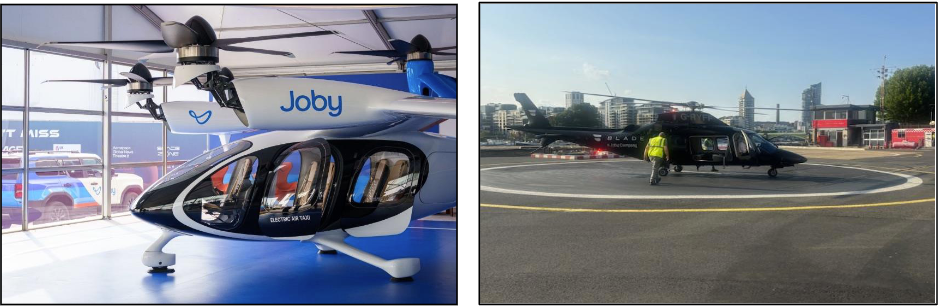
Source: Joby Aviation, Cantor Fitzgerald Research
Similar test flights have run in several US states. Other trials are underway in countries as diverse as Brazil and India. Developments in the Middle East – which had been seen as one of the leading locations for eVTOLs – have been put on hold owing to current conflict in the region. In all locations around the world, journeys are taking place along existing helicopter routes and with pilots (rather than automated computers) operating the vehicles.
The case for eVTOLs versus helicopters ought to be clear. The former are markedly quieter (by up to 100 times, on most estimates), have no single point of failure and are explicitly built with multiple redundant systems. At the same time, eVTOLs are not trying to compete against multi-hour flights or car journeys. The idea is that passengers could fly from downtown Manhattan to the airport in less than 10 minutes. By car or train this could take an hour. Alternatively, imagine flying into Newark, taking a drone to JFK airport, and then connecting through to your next destination.
eVTOLs could be transformative in an urban context. Cities are constrained by fixed road and rail capacity. Travel times are non-linear and unreliable – think about rush-hour gridlock. By contrast, eVTOLs bypass ground congestion entirely, operating point-to-point in the air and delivering predictable, linear journey times. They effectively unlock a new dimension of capacity. Urban transport today is 2D (roads, tracks) and expanding via new rail routes or road widening it is expensive and slow. eVTOLs add effective 3D capacity without major land use changes. Consider too the potential environmental benefits of increased transport electrification and accompanying lower emissions.
Booking an air taxi could be a lot like hailing a ride on Uber or Lyft (Uber even previewed its ‘Uber Air powered by Joby’ service at a press event in Dubai in February, just days before hostilities began). Riders simply enter their destination in the where to? bar, as usual. If their trip qualifies, Uber Air powered by Joby will appear as an option. With one tap, the app can then book every leg of the journey, including Uber Black pickup and drop-off at Joby vertiports.
For many, your author included, taking an eVTOL sounds like an enticing proposition. But does it make economic sense? Today, the effective cost per passenger mile is equivalent to that of a helicopter ride. Over time, the industry believes that taking an eVTOL will be equivalent to a paying for a premium ride-hailing service – only five to ten times faster, and at greater safety than in a helicopter or even driving on the ground.
In any discussion over eVTOL economics several factors need to be considered. These include utilisation – hours in flight – and load factor, or passengers per flight. Battery life, turnaround and charging time will also play a role, as will whether eVTOLs are piloted manually versus autonomously. The latter can reduce the cost per flight by up to a third, according to most industry experts. Clearly, as the overall eVTOL ecosystem scales (and shifts towards autonomy), payback periods will come down, and unit economics correspondingly improve.
Most forecasts from consultants and investment banks size the eVTOL industry as being worth up to $30bn over the next decade. These models typically assume limited fleet sizes, early infrastructure and premium pricing (niche use cases). More optimistic scenarios include substitutions away from other transportation sources. Morgan Stanley believes the overall market could be worth at least $1.0tr by 2040, if logistics and freight use cases were included too.
The debate is not whether a market exists, but how quickly adoption broadens. The critical distinction is between technological feasibility and commercial viability. The former appears increasingly proven; the latter remains open to debate. The industry has had numerous false starts (not to mention several bankruptcies). There are lots of variables and many unknowns. Regulatory certification for eVTOL is unprecedented owing to its novel architecture. One high-profile incident, particularly early in deployment, could materially slow adoption and tighten regulation.
Consider next the economics. What if battery technology plateaus and energy density upside stalls, constraining range, payload and economics? Further, real-world battery degradation rates and life cycles may prove worse than lab assumptions, especially under fast-charging and high utilisation. Imagine what might happen were autonomy delayed or never approved. Ground-based transportation alternatives to eVTOLs may also improve. Better urban planning and more autonomous cars may erode some eVTOL advantages.
Two additional under-appreciated constraints for eVTOLs come in the form of airspace integration and ground infrastructure. Remember that eVTOLs are not simply new aircraft – they introduce high-frequency, low-altitude urban traffic into airspace today that is lightly used (helicopters, drones) and not designed for dense point-to-point flows. Scaling the eVTOL industry implies a potential move to thousands of flights per day per city. Current manual air traffic control systems would need to be automated. Without automation, controller workloads become the bottleneck long before demand.
At the same time, vertiports (dedicated eVTOL take-off and landing sites) are not trivial. A functioning network would require not only take-off and landing pads, but passenger handling, charging infrastructure and safety zones. Integration into urban transport nodes also matters. Location scarcity constitutes a key constraint, for vertiports must sit close to demand centres such as central business districts and airports. However, in dense cities, land is scarce and planning permissions are difficult, implying high costs, accompanied by potential political friction. Even if eVTOLs are quieter than helicopters, community acceptance may be another issue. Vertiports may end up being a scarcer asset than new aircraft.
Given current constraints, the eVTOL industry has consolidated from around 250 companies five years ago to fewer than 10 meaningful businesses today. The two main listed players are Joby Aviation and Archer Aviation. Both are US-listed, capitalised at around $5bn and remain loss-making. Uber Technologies was arguably the original commercial developer of urban air mobility, developing the modern air taxi network concept before selling its Uber Elevate division to Joby. Today, Uber is positioning itself as a platform, seeking to act as a demand aggregator, whereby eVTOL rides are booked via its app and integrated alongside its cars.
Both Joby and Archer benefit from strong partner ecosystems. The former has a manufacturing partnership with Toyota and investments from Delta Airlines and Uber, with a view to integrating eVTOLs into their respective ecosystems. Equally, Archer’s investors include Stellantis, Boeing and United Airlines; United has placed an order for 200 eVTOLs. The two businesses have said on recent conference calls with the investment community that they hope to begin commercial eVTOL flights in the next 6-12 months. Archer has also been selected as the Official Air Taxi Provider of the LA28 Olympic Games. These begin in less than two years’ time.
Other smaller listed players include Vertical Aerospace, Eve Holdings, Beta Technologies and Lilium. The first of these benefits from partnerships with Honeywell and Rolls Royce, while Eve is working with Embraer to develop eVTOL services in Brazil. China’s leading eVTOL business, EHang, is NASDAQ-listed (and also loss-making).
An entire ecosystem will develop around eVTOLs creating potential investment opportunities in related adjacencies in areas such as component manufacturing, electrification, batteries, dedicated materials, simulation software and even infrastructure and air traffic control systems.
Your author is awaiting take-off with excitement. Are you?
Alexander Gunz
September 2026
The above does not constitute investment advice and is the sole opinion of the author at the time of publication. Heptagon Capital is an investor in Uber Technologies. The author of this piece has no personal direct investment in the business. The author of this piece has a personal direct investment in Archer Aviation. Past performance is no guide to future performance and the value of investments and income from them can fall as well as rise.
Disclaimers
The document is provided for information purposes only and does not constitute investment advice or any recommendation to buy, or sell or otherwise transact in any investments. The document is not intended to be construed as investment research. The contents of this document are based upon sources of information which Heptagon Capital LLP believes to be reliable. However, except to the extent required by applicable law or regulations, no guarantee, warranty or representation (express or implied) is given as to the accuracy or completeness of this document or its contents and, Heptagon Capital LLP, its affiliate companies and its members, officers, employees, agents and advisors do not accept any liability or responsibility in respect of the information or any views expressed herein. Opinions expressed whether in general or in both on the performance of individual investments and in a wider economic context represent the views of the contributor at the time of preparation. Where this document provides forward-looking statements which are based on relevant reports, current opinions, expectations and projections, actual results could differ materially from those anticipated in such statements. All opinions and estimates included in the document are subject to change without notice and Heptagon Capital LLP is under no obligation to update or revise information contained in the document. Furthermore, Heptagon Capital LLP disclaims any liability for any loss, damage, costs or expenses (including direct, indirect, special and consequential) howsoever arising which any person may suffer or incur as a result of viewing or utilising any information included in this document.
The document is protected by copyright. The use of any trademarks and logos displayed in the document without Heptagon Capital LLP’s prior written consent is strictly prohibited. Information in the document must not be published or redistributed without Heptagon Capital LLP’s prior written consent.
Heptagon Capital LLP, 63 Brook
Street, Mayfair, London W1K 4HS
tel +44 20 7070
1800
email [email protected]
Partnership No: OC307355 Registered in England and Wales Authorised & Regulated by the Financial Conduct Authority
Heptagon Capital Limited is licenced to conduct investment services by the Malta Financial Services Authority.


.jpg)

.png)



Receive the updates
Sign up to our monthly email newsletter for the latest fund updates, webcasts and insights.